Three Campuses, 15.36 MWp: Solar Hybrid MiniGrids for Nigerian Federal Universities
1The Three Lots
| Lot 3 — FU Lafia Nasarawa | Lot 4 — FU Lokoja Kogi | Lot 8 — FUT Akure Ondo | |
|---|---|---|---|
| Contract ref | AfDB-NEP/EEP-3/SHMG-03 | AfDB-NEP/EEP3/SHMG-04 | AfDB-NEP/EEP3/SHMG-08 |
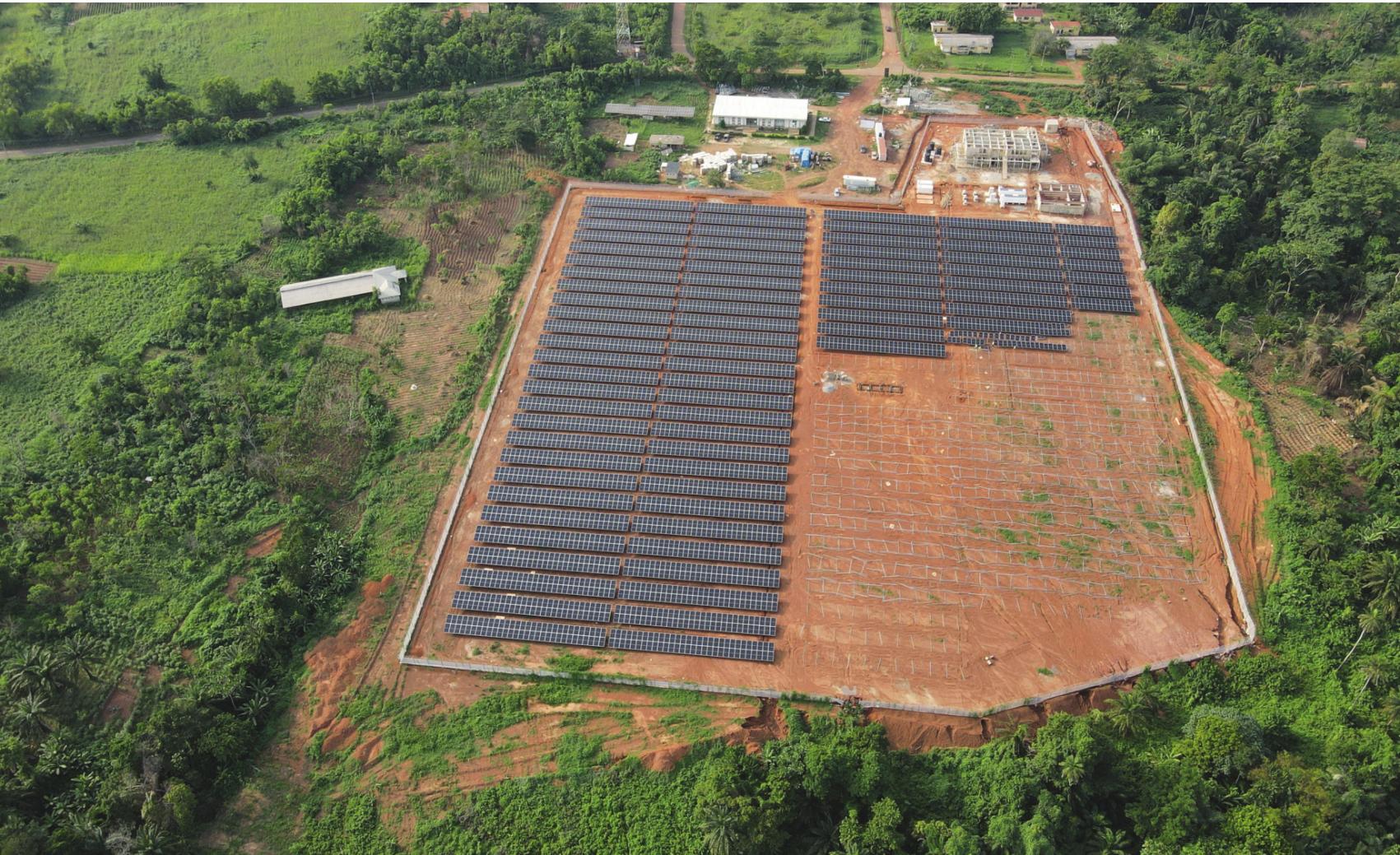
| Solar PV | 4.64 MWp / 3.98 MWac | 5.22 MWp / 4.2 MWac | 5.5 MWp / 4.84 MWac |
| Battery | 4.58 MWh / 2.29 MW Sungrow | 4.58 MWh / 2.29 MW Sungrow | 5.5 MWh / 2.75 MW Sungrow |
| Diesel backup | 1 MVA | 1 MVA | 1 MVA |
| Distribution | 6.2 km @ 11 kV / 0.415 kV | 5.2 km @ 11 kV / 0.415 kV | 8.9 km @ 11 kV / 0.415 kV |
| Street lighting | 247 lamps | 200 lamps | 352 lamps |
| Completion | 12 Jan 2026 | 12 Jan 2026 | 20 Mar 2026 |
| Contract value | US$9,928,965.06 | US$9,020,895.00 | US$11,761,252.19 |
Combined: 15.36 MWp / 13.02 MWac solar; 14.66 MWh / 7.33 MW battery storage; 3 MVA diesel backup; 20.3 km of 11 kV / 0.415 kV distribution; 799 street lights.
All three lots share the same smart metering package — smart meters (KELM), AMI (SteamaCo), remote monitoring (Inaccess / Power Factors) — and each includes a Renewable Energy Workshop and Training Centre.
2Execution Record
| Milestone | Date |
|---|---|
| Bids submitted | 22 June 2023 |
| Letters of Acceptance issued | 21 December 2023 |
| Contracts entered into | 1 February 2024 |
| Completion — Lots 3 and 4 | 12 January 2026 |
| Completion — Lot 8 | 20 March 2026 |
| Certificates issued | 27 March 2026 |
Each certificate marks the commencement of the Defects Liability Period, and each was issued against ADB Loan No. 200200003401 and AGTF Loan No. 5050200000551 under RFP No. AfDB-NEP/OCBI/IFB/EEP-III/DSI-01.
3Government Delivery and Its Social Return
The programme is real, funded and independently reported
EEP Phase III is financed by the African Development Bank Group across eight federal universities and one teaching hospital, deploying 36.5 MW of solar hybrid capacity. The African Development Bank has reported the programme as expected to benefit more than 180,000 students and staff, install over 5,300 smart meters, deploy more than 2,500 streetlights, and significantly reduce diesel dependence. Approximately 160 female STEM students have begun receiving dedicated hands-on technical training, with further students gaining practical exposure through the Renewable Energy Workshop and Training Centres. The three lots described here represent 15.36 MWp of that 36.5 MW.
What it costs a university to be unreliably supplied
The Vice-Chancellor of the Federal University of Lafia has described monthly electricity bills reaching approximately ₦25 million even with unreliable supply, and has stated that the intervention allowed the institution to redirect resources to research and other priorities. That is the mechanism by which a power project becomes an education project: money spent on diesel and tariffs is money not spent on laboratories, staff and research. The return does not require any assumption about behaviour — it is a straight budgetary substitution.
What reliable campus power changes
Laboratory work depends on equipment that cannot tolerate interruption, and on refrigeration for reagents and samples. Teaching depends on hours that are not curtailed by outage. Residential campuses depend on lighting and water pumping. Research output in the sciences is directly constrained by whether instruments can be run to completion.
Street lighting is a safety intervention. The 799 lamps installed across the three campuses are not decorative. Campus lighting affects night-time movement, use of libraries and laboratories after dark, and personal safety — and it affects female students and staff disproportionately, since they bear most of the behavioural cost of unlit campuses.

Training centres change what the programme leaves behind
Each installation includes a Renewable Energy Workshop and Training Centre. The distinction between installing a plant and building a sector is whether the host institution ends up with people who understand the technology. A training centre at an engineering university, attached to an operating 5 MWp hybrid plant, is a teaching asset as much as an energy asset — students learn on a live system rather than a diagram.
The gender component is explicit programme design, not a by-product
The training of female STEM students in renewable energy design and construction is a stated objective of EEP, not an incidental outcome. Around 160 have begun that training across Phase III. Given that women are under-represented in Nigeria’s energy workforce, and that the World Bank has noted women-headed households in Africa are less likely to have electricity access, building a female technical pipeline addresses a structural gap rather than a symbolic one.
Completion is itself the governance result
Nigerian public infrastructure is frequently criticised for projects awarded, partly executed and abandoned. These three ran the full cycle: competitive international tender under AfDB procurement rules, contract, construction, commissioning, and formal certification with the Defects Liability Period commencing. Multilateral financing brings external procurement discipline and reporting obligations, which is part of why this class of project is more traceable than domestically-funded equivalents.
The wider frame
EEP contributes to Mission 300, the joint African Development Bank and World Bank initiative to reach an additional 300 million people in Africa with electricity access by 2030. Nigeria holds the largest single national access deficit — 86.8 million people, at a 61 per cent access rate — which is why it is central to that programme and why demand for contractors with a certified delivery record here is structural rather than tied to any one administration.
Project Enquiries
International Consolidated Contractors Offshore SAL Ltd · 04 Oguda Close, Maitama, Abuja, Nigeria
Email: info@i-cc.co · Website: www.i-cc.co · Tel: +961 21 614100


Comments
Post a Comment