Utility-Scale Hybrid Generation: The 28 MW Niger State Power Project

1Scope Delivered
| Component | Specification |
|---|---|
| Studies and design | Power/load flow studies, protection coordination studies, system design |
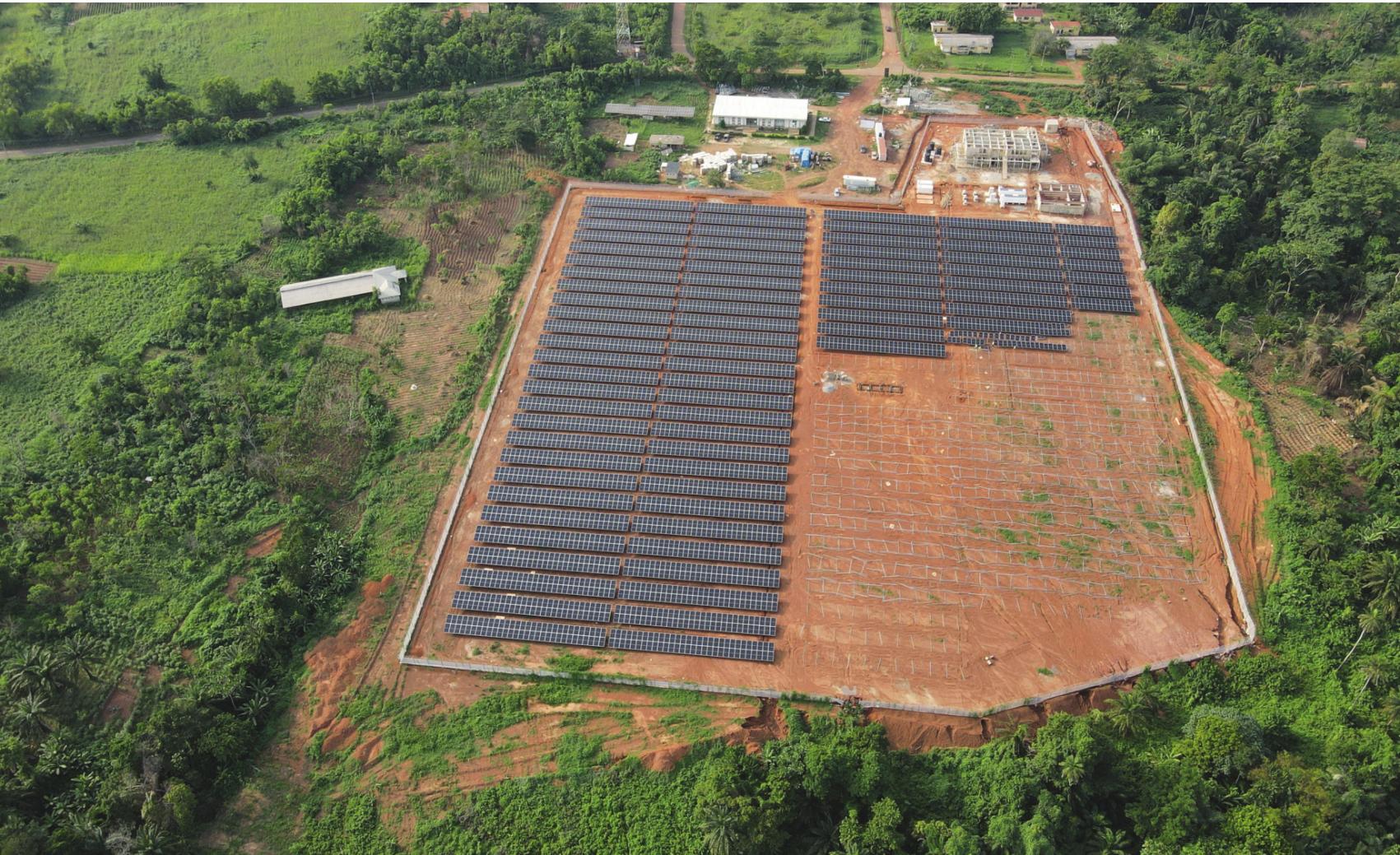
| Solar PV | 33.6 MWp (dc), export power rated at 28 MW (ac) |
| Energy storage | 56 MWh ESS, lithium ferro-phosphate (LiFePO4) |
| Transformers | 50 MVA 0.8/33 kV production transformers for PV, PCS (BESS) and generators |
| Switchgear | 33 kV MV switchgear system |
| Backup | 10 MW synchronised gas-fired generators with re-gasifying system — five generation sets of 2 MW, including one spare on spinning reserve |
| Protection | Plant-side over-current and earth fault protection |
| Control | Energy Management System (EMS) and Battery Management System (BMS) |
| Instrumentation | Portable weather station for data gathering |
| Security | CCTV with night vision and motion sensors; plant perimeter standalone solar lighting |
| Transmission | Transmission infrastructure to point of termination; 50 MVA 33/132 kV power transformer with differential, over-current and earth fault protection, instrument transformers and isolators |
| Grid connection | 132 kV connection at the specified transmission station |
| Operations | 3-year operation and maintenance contract, including projected spare parts and servicing |
2Execution Record
| Milestone | Date |
|---|---|
| Proposal submitted | 1 March 2023 |
| Contract awarded | 20 April 2023 |
| Works commenced | 15 May 2023 |
| Commissioned | 10 May 2024 |
| Certificate issued | 19 July 2024 |
| Operation and maintenance term | 3 years |
Total duration from commencement to commissioning: twelve months.

3The Economic Weight of This Contract
The problem being priced
The World Bank has estimated Nigeria’s annual economic losses from unreliable power at 5 to 7 per cent of GDP — in the order of US$25 billion a year. The constraint is availability rather than nameplate capacity: Nigeria holds roughly 13 GW installed but average available generation has run closer to 4.5 GW. Capacity that is genuinely dispatchable therefore addresses the binding problem, while capacity that merely exists on paper does not.
Why the hybrid configuration is the commercially significant feature
A 33.6 MWp array alone would deliver power on a solar profile and nothing else. Pairing it with 56 MWh of lithium ferro-phosphate storage and 10 MW of gas-fired backup — one unit of which runs on spinning reserve — produces a plant that can be dispatched against demand rather than against sunshine. The certificate’s stated design target of 40–50 per cent of daily energy from solar is the honest characterisation of what a hybrid of this configuration does: it substitutes a substantial share of fuel burn while retaining firm capacity. For an offtaker, that is a materially different and more valuable product than intermittent generation.

Twelve months from site commencement to commissioning
The plant was built, tested and commissioned inside a year, including 132 kV transmission works and a 50 MVA power transformer at the termination point. Grid interconnection is typically the critical path on projects of this type, because it involves a third-party network operator and outage windows that the contractor does not control.
LiFePO4 rather than conventional lithium-ion
Lithium ferro-phosphate chemistry carries lower energy density but materially better thermal stability and cycle life than NMC alternatives. In a hot climate, at a site where the plant must run unattended for years under an O&M contract, that is a lifecycle-cost decision rather than a capital-cost one — and it is the choice a party carrying the maintenance obligation makes, as distinct from one that hands over at commissioning.
Recurring revenue and in-country establishment
The three-year O&M term converts part of the contract into a service position, and requires a standing Nigerian capability spanning PV, battery management, gas generation, HV protection and SCADA. That establishment lowers the marginal cost of bidding subsequent work and represents a durable operating presence rather than a project-duration mobilisation.
Skills concentrated in a scarce category
Nigeria has deep experience in thermal generation and in distribution construction. Utility-scale solar integrated with grid-connected battery storage and synchronised gas backup is a distinct discipline, and the domestic pool of engineers who have commissioned and operated such a plant at transmission voltage is small. Personnel developed on this project represent capability that did not previously exist in the market.
Gas as backup rather than diesel
The generators are gas-fired with a re-gasifying system rather than diesel. Where the fuel supply chain supports it, gas is cheaper per unit and cleaner than diesel, and it insulates operating costs from the diesel price volatility that has repeatedly disrupted Nigerian self-generation economics.
Project Enquiries
International Consolidated Contractors Offshore SAL Ltd · 04 Oguda Close, Maitama, Abuja, Nigeria
Email: info@i-cc.co · Website: www.i-cc.co · Tel: +961 21 614100


Comments
Post a Comment